From intent to done: inside my Herdr setup
My Herdr setup turns what I want into finished work: requests, routines, 28 goals and a coordinator named Orc. And why it's easier at home than at work.
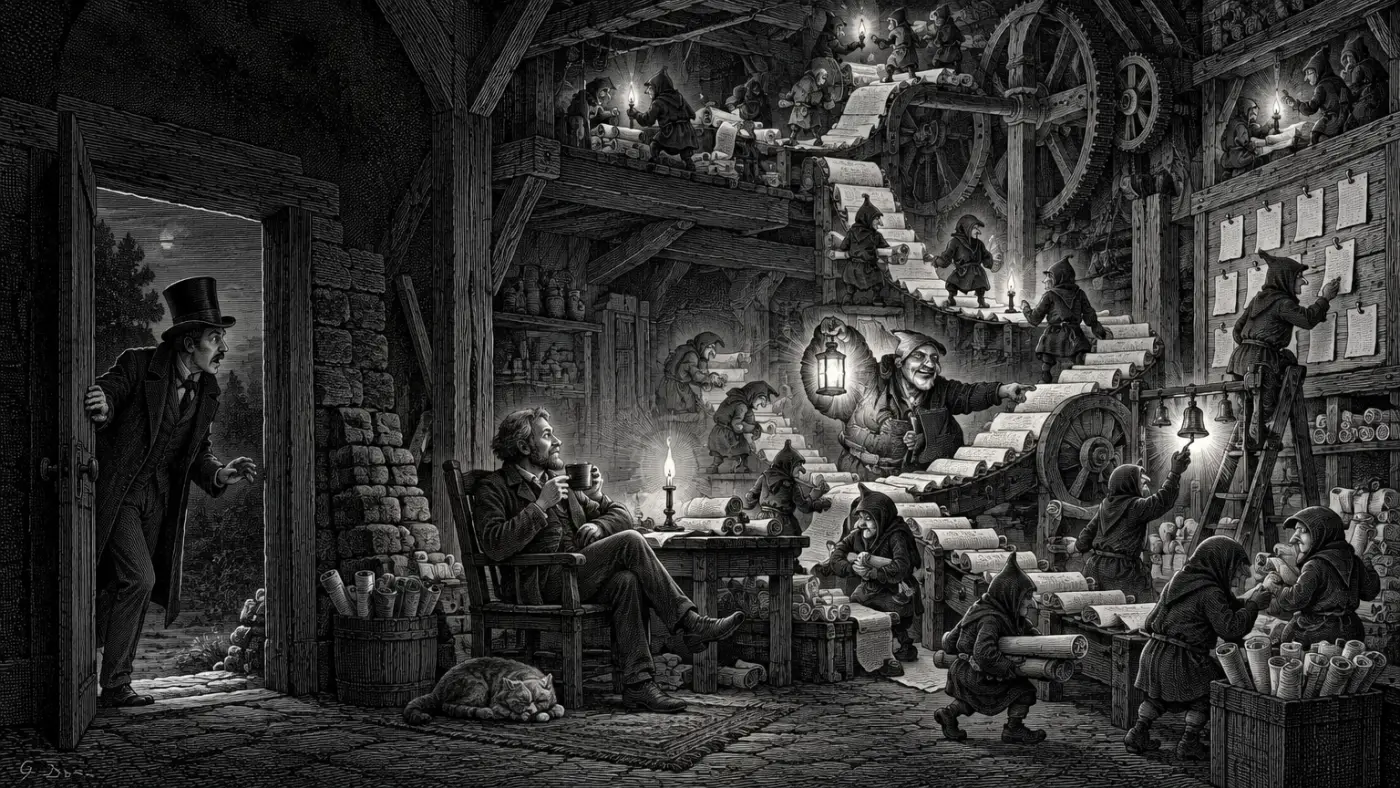
On November 20 I shared a screenshot of my Herdr setup in our #ai-coding channel at work. Our CEO replied "lol wth."
Then: "didn't realize your personal harness was this advanced... you got routines & goals in here."
I do. I have 28 goals, actually. One of them tracks what the other goals cost and works on making them cheaper.
"lol wth"
The thread started small. A teammate saw my screenshot and said they needed goals too, then asked the fair question: how many tokens does all this eat?
My answer was that GPT-6.1 Terra runs most of the resource goals, and that I should probably add a goal for making the goals themselves more efficient. I was half joking. I added it 2 days later.
For scale: my coding agents went from about 1 billion tokens a day in August to about 2 billion now. Herdr's Performance tab shows where the last 30 days went: 43.81 billion tokens in 291,102 model calls, 92% of it read from cache.
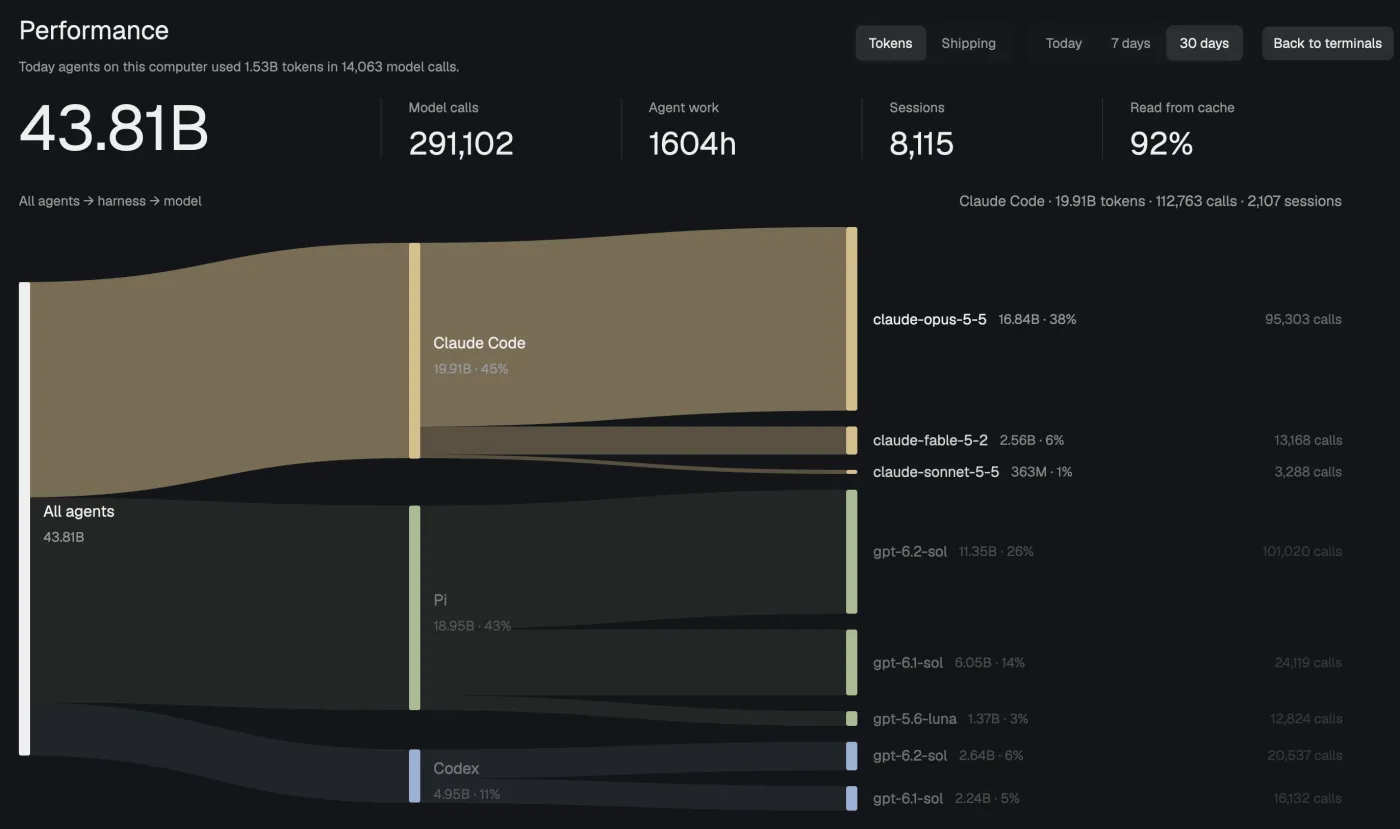
Some context first, because I didn't build Herdr. It's an open-source app for running terminals and coding agents, made by someone else. Its whole interface is a folder of files. Change a file, and the window redraws itself within a second.
So I bolt mods onto it. That's all my config is: 19 mods, about 95k lines, and a coordinator called Orc who has quietly become my favorite coworker.
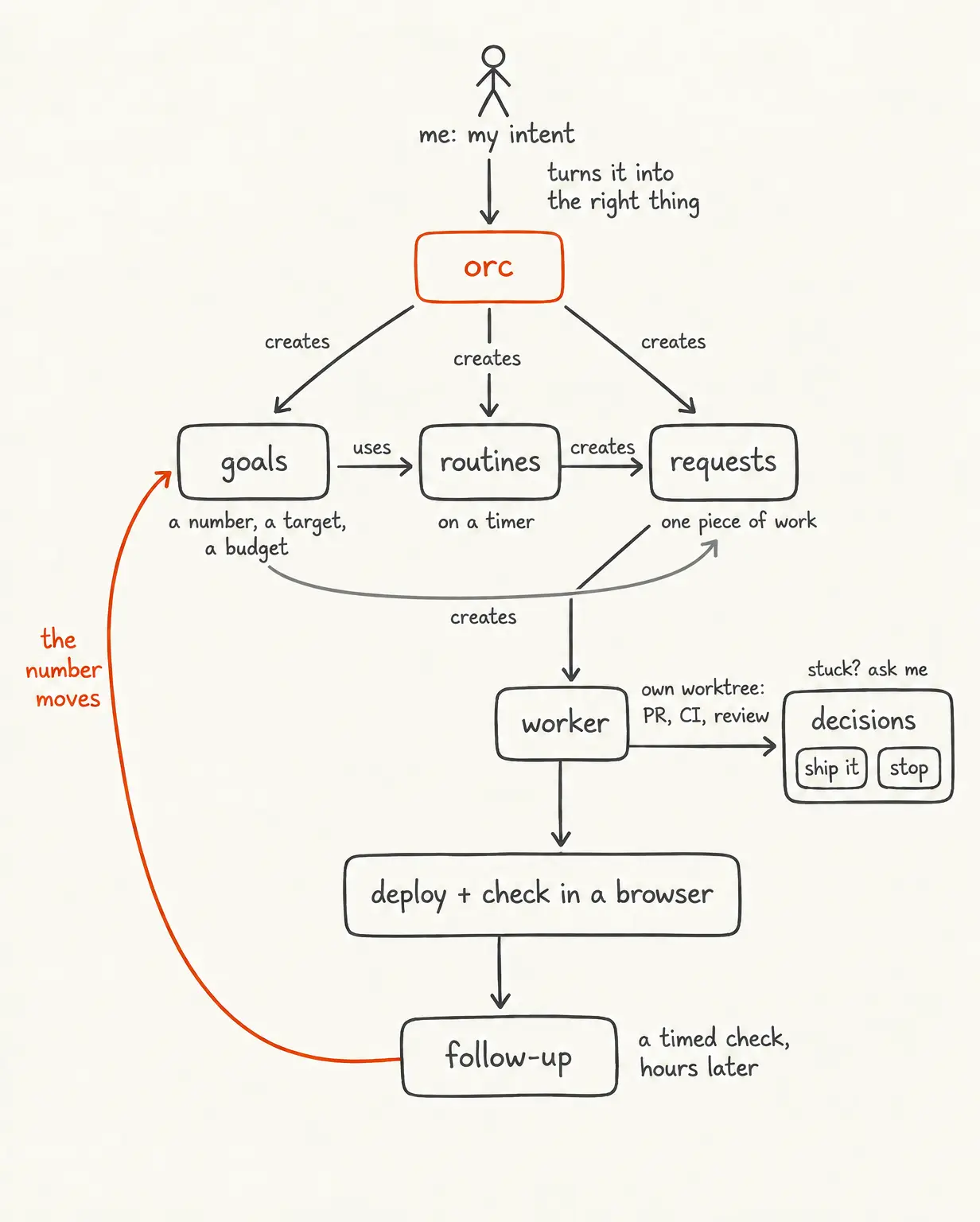
When people ask how I work, I tell them this: I try to get as close as possible to sharing my intent as a request and knowing it will get done the way I want. Everything below exists for that. Each piece also has a feedback loop, so the setup gets a little better every time I correct it.
One request, 8 minutes
The easiest way to explain Orc is to follow one request.
On Wednesday at 11:29 I pasted a screenshot of the Takes homepage into Orc with two words: "takes website." I wanted the old "Download .dmg from GitHub" link gone.
Orc saves the request before any model even runs (so a crash never eats an idea), then hands it to a worker. Each worker gets its own git worktree, and Orc caps them at 3 at a time. The request moves across a board: queued, building, PR and CI, deployed, verified.
At 11:37 the card said verified. In those 8 minutes a worker opened the PR, the full site tests passed, a separate Claude Code session reviewed it, it merged, Cloudflare deployed it, and an agent opened the live site in a real browser to check the link was gone.
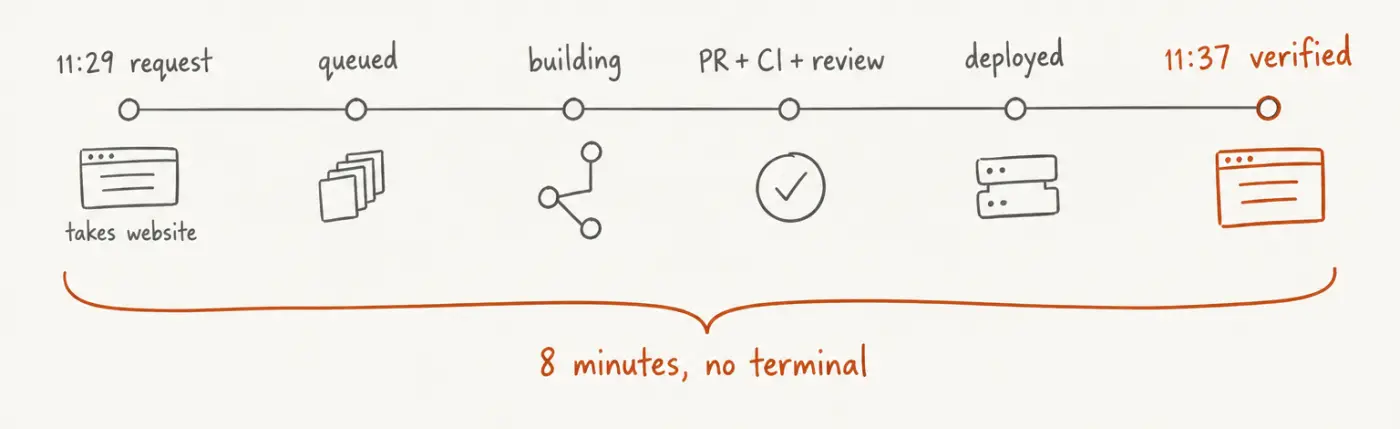
I didn't touch a terminal. I've sent Orc 1,386 requests since November 13. Most are that boring.
The worker needs me
Agents get stuck. They hit a question only I can answer, and in a normal setup that question sits in some terminal tab I won't open for 3 hours.
In Herdr, every question becomes a card in one inbox called Decisions. Each card has the question, what the agent already tried, how sure it is, what could go wrong, and a recommendation. Here's a real one:
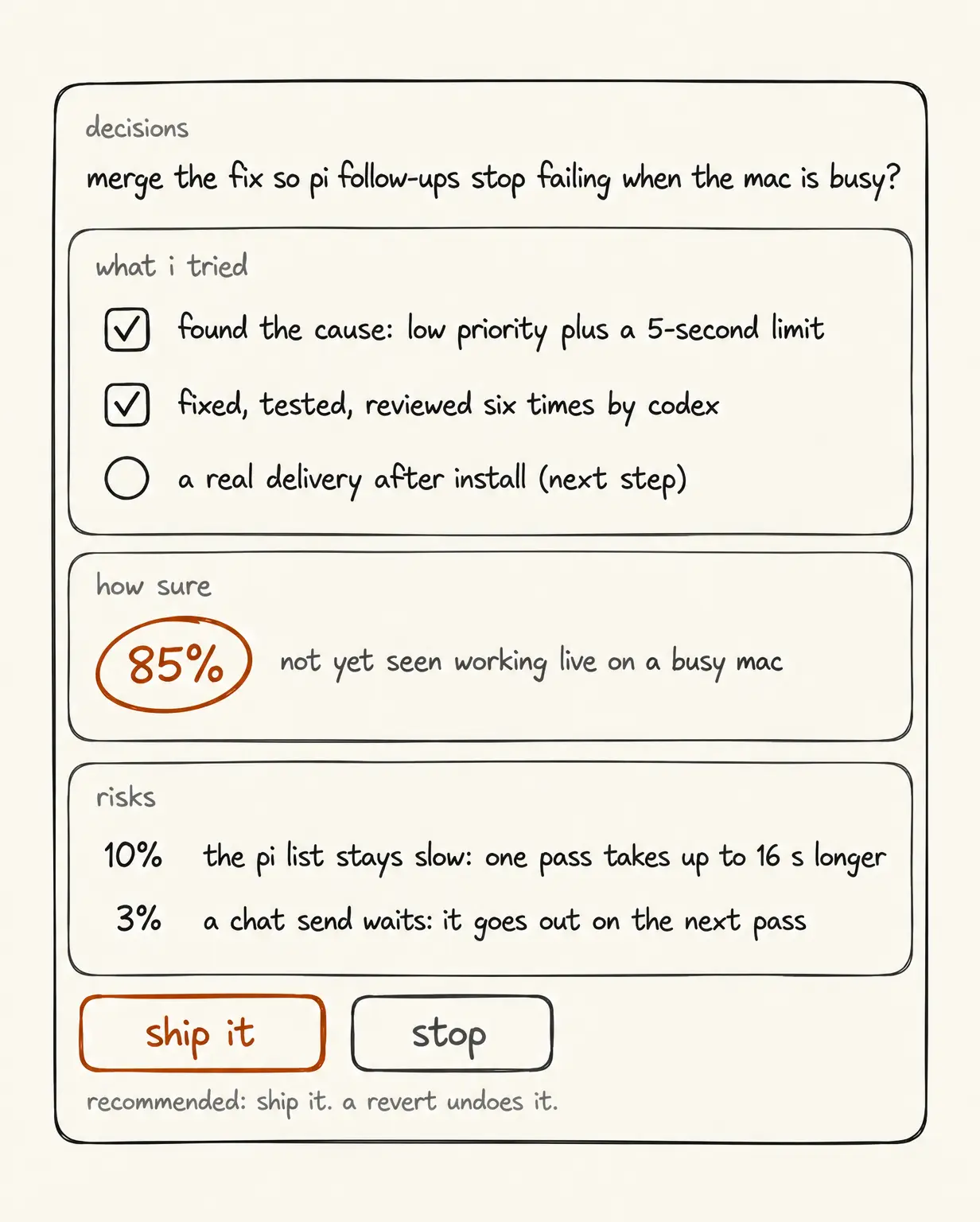
I've answered 548 of these. The instructions I wrote for the merge cards say: "He is not an engineer and will read the card cold: it must let him say yes with confidence in under a minute."
Yes, I wrote that about myself. I read code slowly, so the card has to carry the proof.
Ship, then check later
Merged doesn't mean live, and live doesn't mean it works. So agents can book a follow-up: a timed check that Orc owes me, usually a few hours after the real deploy.
One fix from last week shows why. The first follow-up came back blocked: the last production deploy was built before the fix merged, and the next one had failed a test group. The check rescheduled itself. The second follow-up said the fix went live at 3:12 PM, the live tests passed and nothing was rolled back.
Without that, I'd have told someone "it's fixed" about two hours too early. I have 536 of these on record now.
(The fine print, straight from my own README: follow-ups "cannot run while this Mac is off." Not all of it is local, though: for some of my work, agents run in lndev, Lindy's cloud shells for engineers.)
Routines, and the goal that watches the goals
Some work never ends, so it becomes a routine. A routine is a standing instruction with a trigger, a harness, a model and a time limit. If it fails 3 times in a row, it pauses itself.
My busiest one reviews pull requests waiting on me at work. It wakes every 2 hours, reads each PR and posts a verdict. It has run 317 times. Another one walks my own open PRs and fixes whatever blocks them. A third one asks me every evening which old sessions it can close.
In October, my actual job was migrating Lindy's routines to our new agent runtime. My journal entry from October 10 says: "Rebuilding and testing routines for Raptor and migrating them. Horribly boring."
A few weeks later I built a whole routine system at home, for fun.
Goals sit one level above routines. Each goal has a number Orc reads on a schedule, a target, a budget, and a plan for getting there. A few of mine:
- Keep Mac memory pressure normal (read every minute)
- Leftover worktrees: 0
- Merge PRs in under 2 hours
- JS type errors: 44 to 0
- Personal Gmail inbox to zero
And the one from the Slack thread, "Goal checks with full AI usage totals." It measures the next 20 goal checks, by December 18, before it suggests any savings target. Yes, my goals have a goal.
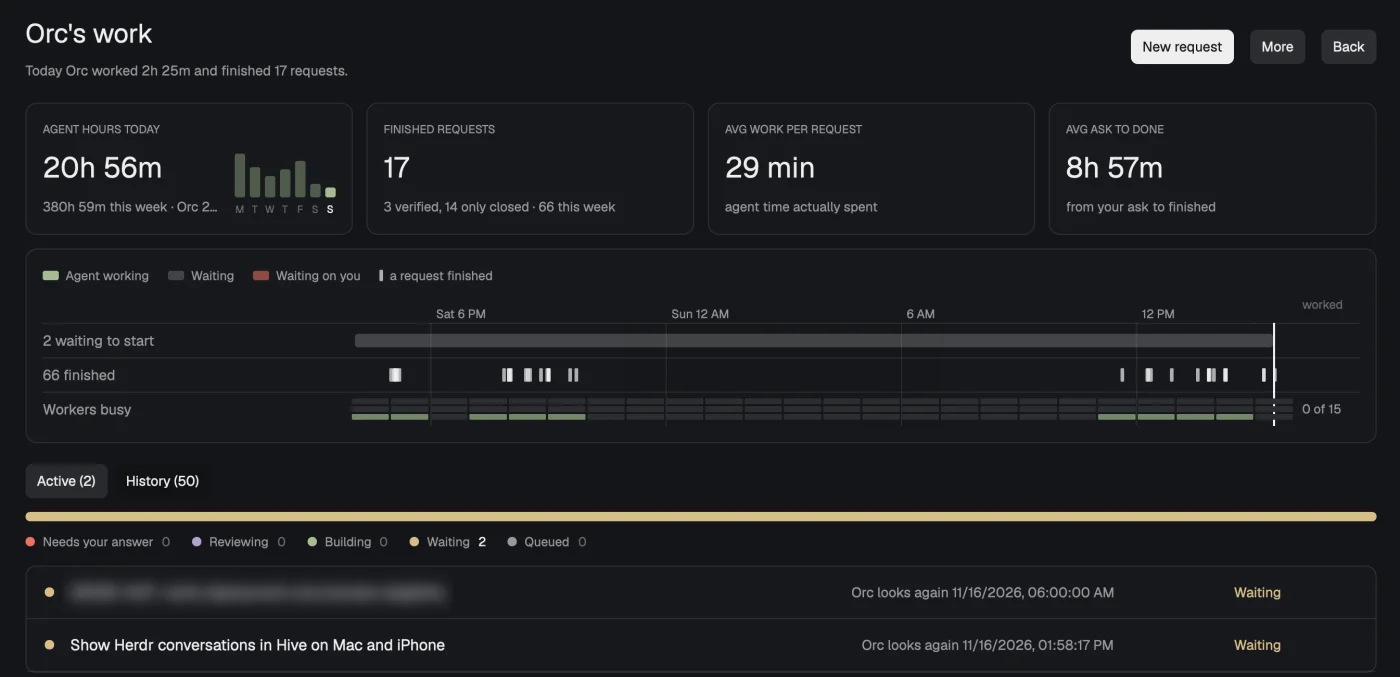
On November 15 I took a screenshot of Orc's board. That day my agents logged 20 hours and 56 minutes of work. That week they logged 380 hours. I'm one person.
"Why is this so easy at home?"
Then our CEO asked a follow-up, one he'd also asked at our engineering all-hands: why is it so easy for each of us to build this on our own machines, when we struggle to do the same at the company?
I wrote back 3 things, and I still think they're right.

- Iteration speed. This is the biggest one. In Herdr it's all mods, so there's no build and no deploy pipeline. I save, and the window changes. At work, the closer a change gets to instant, the better, and we're far from instant.
- One repo, one PR. At work, one change I want often means 2 pull requests in 2 repos, because our agent runtime and our main codebase live apart. Then I have to merge them in the right order and fight 2 CIs.
- One user. At home I build for 1 person: myself. At work I build for every Lindy user, including the many who will never open a settings page.
My home setup is already growing the same habits. Changes now go through a worktree, a 1-minute check script, a review and a PR. The config has 164 merged PRs. Nobody made me do that. 19 mods and a handful of agents editing the same live folder will teach you about merge order fast.
So my home setup is less magic than it looks. Someone built Herdr so I could mod it in seconds. At Lindy, I'm on the team that has to build that for everyone else, with 2 repos, 2 CIs and a lot of users I'll never meet.
That's what we're working hard on now: getting the time from sharing intent to shipped code close to instant, so we can excel at execution.